Every month we hear the same handful of worries from different households. This section answers them once, clearly, so you can read at your own pace and call when you are ready.
- Bulletin 1Full-View Glass Garage Door Installation: getting readyYour renovation has given the house clean modern lines, but the old raised-panel garage door now looks out of place. You want broad glass panels and a slim dark frame to complete the exterior.Read
- Bulletin 2High-Lift Garage Door Conversion: reading the quoteTypical system changes include vertical and transition track, raised horizontal track supports, high-lift drums, longer lift cables, calculated torsion springs and related shaft or bearing hardware. Top fixtures…Read
- Bulletin 3Photo-Eye Sensor Alignment or Replacement: step by stepYour opener has been trying to tell you what is wrong. The head unit flashes its light a set number of times, or blinks a pattern on its up and down arrows, and each pattern maps to a cause on the maker's chart: beam…Read
Straight talk
Repair & Maintenance
What exactly gets looked at during the inspection?
The whole system, not just the opener. Sections, hinges, rollers, tracks and their fasteners; springs, cables, drums and bottom brackets; the bottom seal and perimeter weatherstrip; the opener head, rail, arm and mounting; the photo eyes, contact reversal, wall control, remotes, keypad and manual release; and the warning labels. Each is examined, and the door is tested both by hand and under power. Garage Door Safety Inspection
What should I do if the bottom seal freezes to the floor?
Do not keep pressing the button; the opener can tear the seal or pull the top section out of shape. Free the seal by clearing the ice along the threshold, with warm water poured on the concrete rather than the door, or by working a plastic scraper along the seal. Then treat the seal with a silicone spray. Keeping snow and meltwater cleared from the threshold and keeping the seal flexible with silicone prevents most repeats. Garage Door Tune-Up
One side of my door hangs lower than the other. What does that mean?
A door that sits tilted almost always has a lifting cable that has gone slack, unwound from its drum or broken on the low side. The springs are still pulling on the other side, which is why the door racks and the rollers escape. Leave it where it is; levelling it means handling the springs and rewinding both cables evenly, which is done with the door clamped and the tension controlled. Off-Track Garage Door Reset
Can the replacement section be a different style, as an upgrade?
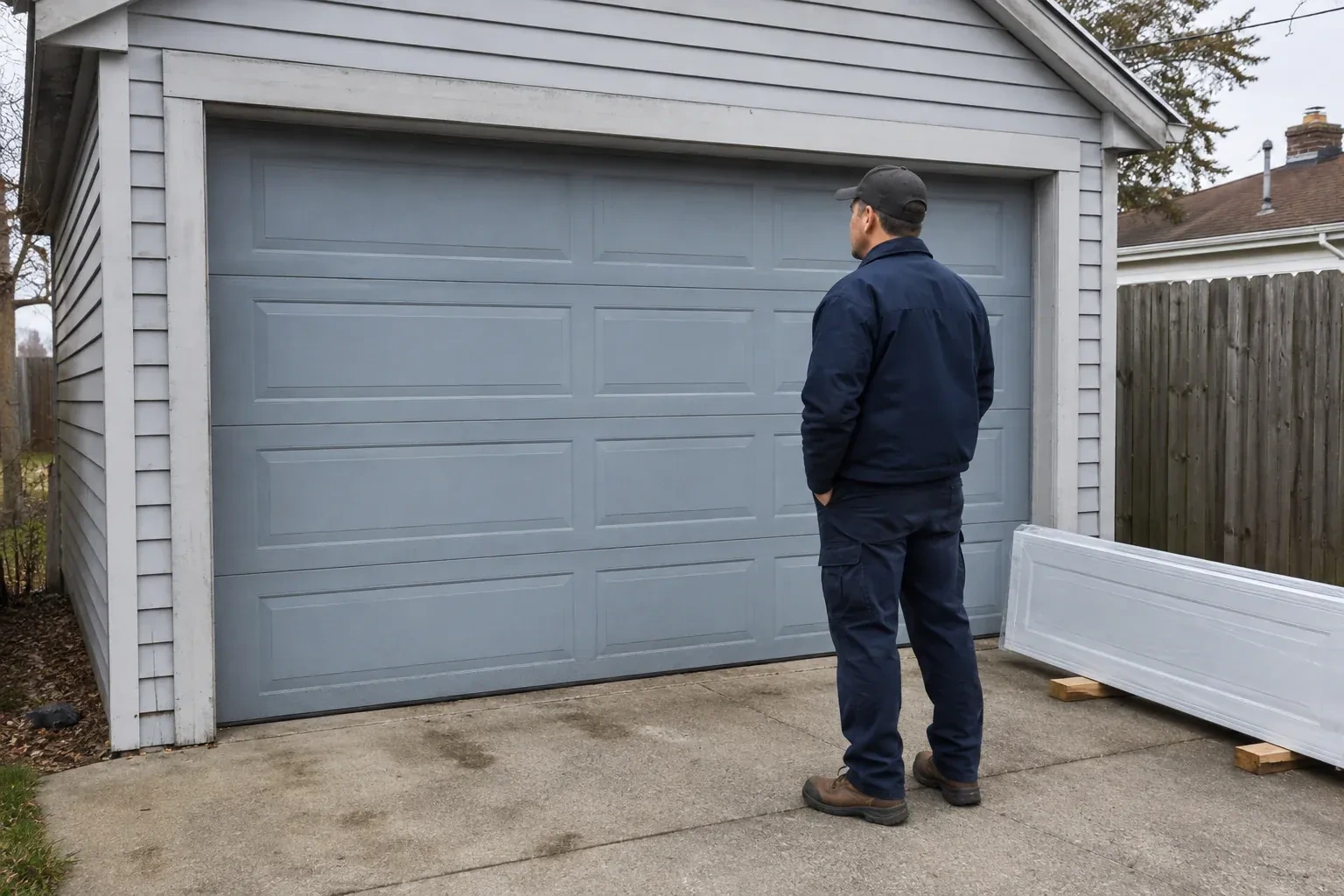
Within one door, sections need to share the same joint profile, thickness and hinge spacing, so a section from a different design generally does not mate with its neighbours. What you can change is a detail the manufacturer offers for your model, such as ordering the top section with windows or adding decorative hardware. If you want a genuinely different look or insulation level, that is a conversation about a new door rather than one section. Garage Door Panel Replacement
Springs & Hardware
How does the technician tell rollers from hinges or track as the cause?
By watching where and when the trouble happens and then checking the parts in that spot. Rollers are spun and wiggled to reveal rough bearings and worn wheels; hinges are checked for cracks, elongated holes and loose bolts; tracks are checked for plumb, dents and spacing. A shudder at the curve tends to be rollers, a pop as sections pivot tends to be a hinge, and a rub the full height of the door tends to be track. Often more than one is involved, and the visit covers them all. Garage Door Roller Replacement
What information helps when I book the visit?
Whether the door is closed, open or stuck; where the noise or the gap appears and roughly how high; whether you can see a cracked, bent or loose hinge and whether it is at the edge or the middle; whether the door is a single or a double, steel or wood, and how many panels it has; and whether anything hit the door lately. A photo of the hinge and its stamped number is useful. Garage Door Hinge Replacement
My door came off its track last month. Is this the same service?
It is the follow-on. Putting a door back on its track deals with the rollers and gets the door running again; track repair deals with the reason it left. If the reset showed a spread channel, a bent section or loose brackets, those are corrected now so the rollers stay put. Where nothing on the track was at fault and the cause was a cable or an obstruction, the track is simply checked and confirmed. Garage Door Track Repair or Replacement
Do I need new cables when the springs are replaced?
Often it is sensible. Cables and springs are similar in age, and with the counterbalance already unloaded the extra work of fitting new cables is small. The technician inspects them and advises: cables with bright, tight strands and clean loops can stay and simply be re-tensioned, while cables with any fraying or rust at the bottom are better renewed now than in a separate visit later. Garage Door Cable Replacement
Openers & Access
What is the red cord for, and is it safe to pull?
It is the emergency release that disconnects the door from the opener so you can move it by hand, for instance during a power outage. It is safe when used with the door closed. Pulling it with the door open is the risk, because an unbalanced door can then drop. Pull straight down, lift the door by its handle, and reconnect afterwards by running the opener or lifting until the trolley clicks back in. Garage Door Opener Diagnosis and Repair
Should I use the slide lock on the door with a chain drive?
No. The manual slide lock on the door is disabled or removed once an operator is connected, and the technician checks that during the repair. A motor pulling against a locked door strains the chain, strips the drive gear and can bend the top section of the door. If you want the door secured against remotes, the lock button on the wall control switches them off, and a track lock designed to work with an operator does the rest. Chain-Drive Opener Repair
What is the difference between belt-drive repair and opener replacement?
Repair keeps the operator you have and renews the piece of the drive that has failed: the belt, its tension, the trolley, the idler pulley or the gear and sprocket at the motor head. It suits a unit with a sound motor and board, photo eyes near the floor and rolling-code remotes. Replacement is the answer when the operator predates those features or when its board or motor has failed and is no longer made. Belt-Drive Opener Repair
What happens to the old opener?
The technician takes it away. The steel rail, chain and angle iron go to metal recycling and the head unit, with its motor and circuit board, goes to electronics recycling rather than the landfill. Old remotes are cleared from memory before they are discarded or handed back to you, and any wiring that is not being reused is removed from the ceiling and walls so the garage is left tidy. Garage Door Opener Replacement
Installation & Upgrades
Can I add windows without losing privacy?
Yes. Window location, glass treatment and viewing height can be selected together. Frosted, textured or obscured glazing admits daylight while limiting direct views, subject to the available options for the chosen door. Glazing also changes weight and thermal performance, so it belongs in the original order and counterbalance specification. Sectional Garage Door Replacement
Why is manual balance tested before the opener?
The electric operator is intended to move a correctly counterbalanced door, not substitute for spring adjustment. Disconnecting it lets the installer feel resistance directly and observe whether the door remains manageable at different positions. This check can reveal track binding, cable differences or an unsuitable counterbalance setting before powered limits and safety functions are tuned around the completed assembly. Insulated Steel Garage Door Installation
Why are both positive and negative pressures important?
Wind can push a closed door toward the garage or create suction that draws it outward. Those actions load sections and hardware differently, including rollers, hinges, tracks, and attachments at the jambs. A suitable configuration addresses both directions using the pressure values and details established for the project rather than treating reinforcement as resistance in only one direction. Wind-Rated Garage Door Replacement
Which materials are used for carriage-house garage doors?
Common choices include embossed steel sections, insulated steel with composite overlays, and wood or wood-faced sectional construction. They differ in weight, surface depth, grain, moisture response and care. Samples are helpful because photographs can flatten texture and alter colour. The chosen construction also guides spring sizing, reinforcement, fasteners and the kind of finish maintenance expected later. Carriage-House Garage Door Installation